
Bitcoin is struggling to regain momentum below the $88,000 level as fear and uncertainty continue to weigh on market sentiment. After a volatile selloff, price action remains compressed near key support, with buyers hesitant to step in aggressively and sellers pressing rallies at lower levels. While attention has largely focused on derivatives pressure and macro risk, on-chain signals are now adding another layer of concern to the current setup.
Top analyst Darkfost points to a critical indicator of Bitcoin’s underlying network health: the hashrate, which measures the total computing power securing the network and reflects overall mining activity. Under normal conditions, a sharp decline in hashrate suggests that miners are voluntarily shutting down machines, often due to unprofitability or stress—typically associated with miner capitulation phases near market lows.
That is exactly the type of move unfolding now. Over just two days, Bitcoin’s hashrate has dropped dramatically, falling from 1.133 ZH/s to 690 EH/s. Such a rapid contraction is highly unusual and immediately raises questions about its cause. Importantly, Darkfost notes that this episode does not fit the classic miner capitulation narrative driven by collapsing prices or shrinking margins.

Instead, the decline appears to be linked to external disruptions rather than economic pressure within the mining sector itself. This distinction matters. While price remains under pressure below $88K, the hashrate shock introduces a new variable—one that could influence short-term dynamics, miner behavior, and market psychology as conditions evolve.
Hashrate Shock Linked To US Ice Storm, Not Miner Capitulation
According to Darkfost, the sharp drop in Bitcoin’s hashrate appears to be driven by external disruptions, not by economic stress within the mining sector. A large number of ASIC machines have been shut down during the past few days, coinciding with a severe ice storm hitting the United States, a country that accounts for roughly one-third of global Bitcoin hashrate. The timing strongly suggests a weather-related shock rather than voluntary miner capitulation.
The cold wave has been especially disruptive in Texas, a key hub for industrial-scale mining operations. Major players such as MARA and Foundry Digital are heavily exposed to the region’s power grid. Darkfost highlights that MARA’s hashrate has fallen by roughly a factor of four over the last three days compared to its monthly average, underscoring how abrupt and severe the disruption has been.
Extreme cold places stress on power infrastructure, forcing grid operators to curtail non-essential loads, while electricity prices spike as demand surges. For miners, this combination makes continued operation temporarily unviable, leading to widespread shutdowns.
As a consequence, block times are likely to lengthen, and mining difficulty is expected to adjust lower, with the next adjustment already estimated near -4.54%. If the storm persists, Darkfost warns that some miners could be forced to sell BTC to cover fixed operating costs, adding another short-term pressure point for the market.
Bitcoin Medium-Term Structure Remains Under Pressure
Bitcoin is trading around $87,850 on the 3-day chart, sitting at a critical inflection zone after a prolonged corrective phase. The broader structure shows that BTC peaked near the $125K area in late 2025 before entering a sustained downtrend, marked by sharp selloffs and increasingly weaker rebound attempts. While price has managed to stabilize above the mid-$80K region, momentum remains fragile and conviction on the buy side is limited.
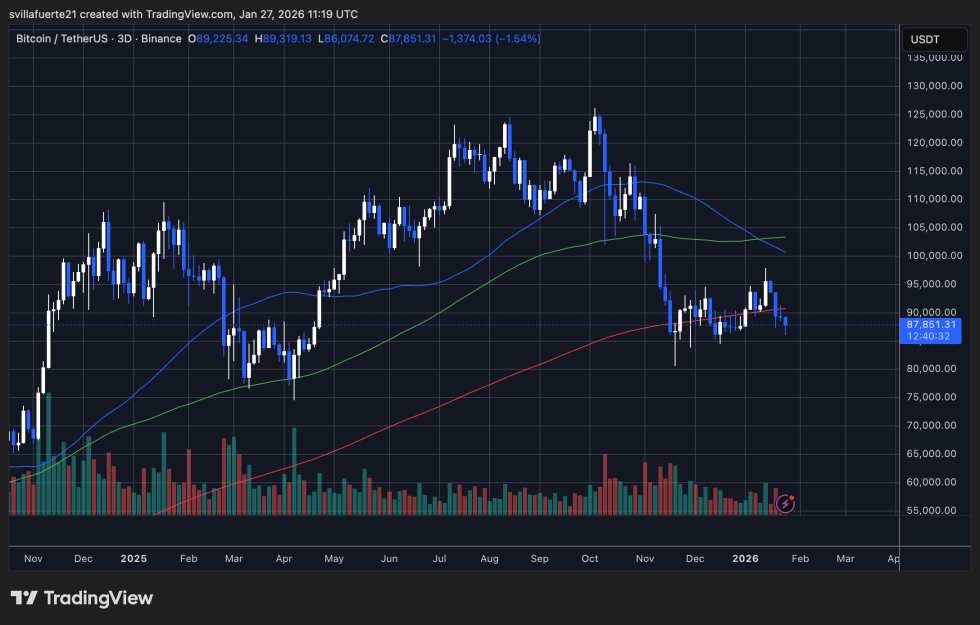
From a trend perspective, the moving averages outline the current market regime clearly. Bitcoin is trading below the 50-period moving average (blue), which has rolled over and is now acting as dynamic resistance near the low-$90K area.
The 100-period moving average (green) is flattening and beginning to turn lower, signaling a loss of medium-term trend strength and confirming that prior upside momentum has broken. Meanwhile, the 200-period moving average (red) continues to slope upward well below price, near the low-$90K to high-$80K region, acting as the last major long-term support reference.
Price action over recent candles suggests compression rather than capitulation. Volatility has contracted, and volume has declined compared to the November selloff, indicating reduced urgency from sellers. For bulls, holding the $86K–$88K zone is essential to avoid a deeper breakdown.
A decisive move back above $90K–$92K would be required to shift structure and signal early recovery, while failure here keeps downside risk open toward the low-$80K range.
Featured image from ChatGPT, chart from TradingView.com

You can get bonuses upto $100 FREE BONUS when you:
💰 Install these recommended apps:
💲 SocialGood - 100% Crypto Back on Everyday Shopping
💲 xPortal - The DeFi For The Next Billion
💲 CryptoTab Browser - Lightweight, fast, and ready to mine!
💰 Register on these recommended exchanges:
🟡 Binance🟡 Bitfinex🟡 Bitmart🟡 Bittrex🟡 Bitget
🟡 CoinEx🟡 Crypto.com🟡 Gate.io🟡 Huobi🟡 Kucoin.

















Comments